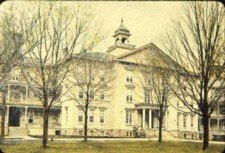
Second Biennial Report
REPORT OF SAMUEL BACON
PRINCIPAL OF THE
INSTITUTION FOR THE BLIND
To the Board of Trustees
of the
Iowa Institution for the Education of the Blind
1856
Gentlemen:—The time has arrived for us to review our labors, for the purpose of presenting to you the progress and condition of this Institution. We have spent many anxious moments, yet we have had our pleasures, and have the self-satisfaction to think we have done something for the blind, although not so much as we have desired.
The conduct of all has been such as to meet with our highest approbation. The teachers manifest great interest in the discharge of their duties, the pupils to receive their instruction.
Mr. J. L. Jones has discharged the duties of Music Teacher, in addition to superintending the shop, with credit to himself, since the resignation of T. J. McGittinger, Nov. 15, 1855.
Miss M. C. Christy has discharged the duties of Assistant Teacher since March 10th, 1856. With some more experience, she will make a valuable instructor.
Since our last Report, we have had eight admissions, and one death, Mary Bushnell. She departed this life the 28th of April last. She was the one that appeared before the Legislature, in 1853, to represent her class in Iowa, which resulted in the establishment of this Institution. She was confined to her bed not more than ten days; the victim of premature decline resulting from early physical neglect. She had all the attention it was possible to give her, from friends and sympathizing fellow pupils, to whom she had endeared herself. She was interred with due respect by the Catholic Church, to which she belonged.
With this exception, by the prompt attention of the Institution Physician, Dr. H. Murray, the health of the inmates had been good.
The course of instruction is thorough and as extensive as the age of the Institution will admit. There are three Departments, Academical, Musical, and Industrial, each of which, has its allotted portion of time; there is ample time left for recreation. The pupils rise at half past five, breakfast at seven, dine at half past twelve, tea at half past five, retire at nine. School commences at six in the morning, and from that until half past twelve; three hours devoted to Literary branches, and two to Music; afternoon, two to Labor, and one to Literary; one hour in the evening is devoted to reading some useful book. The academical course at present embraces Geography, Reading Raised Print, Writing, Grammar, Logic and Rhetoric, Arithmetic, Algebra, Plain and Analytical Geometry, and Deferential Calculus. Music embraces the Theory and Compositions as well as Vocal and Instrumental Music. In the Industrial Department the females are employed in sewing, plain and fancy knitting, and bead work. The males are employed in broom and mat making, the latter we do not consider a suitable trade for the blind—the former is excellent. It has been our intention to introduce brush making to a limited extent. In addition to the above courses, the news of the day is read to the pupils from the various papers sent to the Institution gratis, for which the editors have our thanks.
The discipline is mild but firm, free from corporal punishment, keeping the improvement of the pupil constantly in view. We know of no reason why the discipline of the blind should differ a particle from that of the seeing, or the course of instruction.
The manner of conveying that instruction is necessarily different for the want of suitable apparatus, the method pursued is oral, which makes it more thorough and consequently better, but more laborious for the teacher. Notwithstanding the perverseness of human nature it is now generally conceded the blind are human beings, endowed with certain inalienable rights which they ought to be protected in, providing they do not interfere with the desires of others.
During the past vacation myself and Mrs. Bacon visited the Institutions for the Blind of Illinois, Indiana, Ohio, Pennsylvania, New York and Massachusetts for the purpose of procuring apparatus for this institution, and by personal inspection gain such information as their experience may have suggested. The three eastern Institutions from which the others obtain their apparatus are doing nothing in that line, or nearly so, New York being the only place we noticed any attempt at improvement. If they were able to experiment on their plans some result might be obtained which would be very useful to the blind. Those three Institutions have departments, which are, workshops for the older blind who do not wish to attend school. It is a very worthy object, and may their success be equal to their expectations, but it appears to me that this department is a drag on the school. One thing certain, the printing has been suspended, this makes it very difficult to procure much from them, and that at a very high rate, but we have no right to complain of them for not furnishing us with books. If the institutions of the country would unite in forming a fund for the purpose of encouraging some one of the older institutions which is prepared to print, we would all gradually accumulate a library, and such progress might be made for printing for the blind, that the books would be within the means of every blind person.
On my return from the east I visited, in company with some of our pupils, for the purpose of hunting the blind, the counties of Iowa, Poweshiek, Cedar, Clinton, Scott, Jackson, and Dubuque; at the latter place we met with an accident which put a stop to further progress. Jones and Linn having been previously visited. It was our intention to go west, southwest and home again, this ought to be done yet, for we have had an interview with all of our pupils or their parents, with a very few exceptions, before they would enter school. We gave several public exhibitions which were well attended. The people are very ignorant of the advantage this institution affords to the blind, even its existence is almost unknown in some sections which have been visited; such names as have been collected from this and other sources you will find marked “A,” and there are seventeen others reported, names unknown, and in all probability this is not half that ought to be in school, in addition to the present number.
NOBLE STRUCTURES
As I wondered through those of other states which have been reared with so much care and attention to the purpose for which they were designed, it was a sad thought that Iowa was the only one without a suitable building, particularly so when she was brought in contrast with other states. Iowa, which is free from debt, or nearly so, with unparalleled prosperity, while they are involved.
We are now in the fourth building which we have occupied since the first of April, 1853, and our lease for this expires the first of July next, then to be hurled out to go, where, we know not, and break up what little apparatus has been obtained; this is very expensive and unsatisfactory. The interests of the school and public economy demand a building.
While in the east we tried to procure maps but could not, we learned all we could about their manufacture. Mrs. Bacon thinks she could make them if she had time, as she has had some experience, probably there is no other way than to make them ourselves.
The finances so far as they have been entrusted to me, that is, since the first of February, 1855, will accompany this, marked “B,” vouchers for the same have been filed, with the Secretary of the Board. It will be seen that the sales amount to four hundred and sixty-nine dollars and seventy cents. Five dozen brooms and four mats have been used about the house.
In conclusion, gentleman, permit me to thank you for the manner you have responded to all calls made upon you to aid in carrying out the design of this institution, all of which is
Respectfully Submitted
SAMUEL BACON