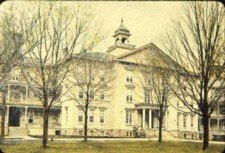
In the late summer of 1852 Samuel Bacon and his wife were visiting friends in Keokuk, Iowa. It was here several interested citizens of the city visited Mr. Bacon to discuss the establishment of a school for several bind in the city. Interest grew as discussions continued and word spread of his establishing a school in Illinois for all blind of Illinois. In
Laws of Iowa
CHAPTER 26
BLIND ASYLUM
AC ACT to establish an Asylum for the Blind.
Section 1. Be it enacted by the General Assembly of the State of Iowa, that there be, and hereby is established, at the Capital of this State, an institution for the instruction of the blind, which shall be known as the Asylum for the Blind.
Section 2. The asylum for the blind shall be under the management and supervision of a board of overseers, consisting of seven persons, of whom the Governor, Superintendent of Public Instruction, and Secretary of State, shall be ex-officio members. The Superintendent shall be President of the board; the other members of the board shall be appointed by the Governor, with the consent of the Senate, and shall hold their offices for one, two, three and four years respectfully, and at the expiration of each of their respective terms of office, one overseer shall be appointed by the Governor, with the consent of the Senate, for the term of four years.
Section 3. The overseers shall have the general supervision of the asylum, adopt rules and regulations for the government, prescribe the course of instruction, see that the principal and other officers of the asylum, discharge their duties faithfully, as provided in this act, or by the rules and regulations established by the board of overseers, provide teachers, servants, and necessaries for the asylum, and to do and perform all acts necessary to render the institution efficient and valuable, not inconsistent with the laws of this State.
Section 4. And three of said overseers shall constitute a quorum for the transaction of business.
Section 5. Upon satisfactory evidence being adduced to the county court of any county in this State that there is a blind person between the age of seven and twenty-two years residing in such county, who is too poor, or whose parents are too poor, to furnish him or her with an education, it shall be the duty of the court to cause the clerk of the court to certify that fact, together with the name, age, address, and cause of blindness of such person, and the name of his parents or guardian, and the place of his or her nativity; to the overseers of the asylum, and upon the receipt of such certificate, the overseers shall admit such person, as a pupil of the asylum, and shall immediately forward a certificate to the Auditor of the State, setting forth that said pupil has been admitted, together with the date of his or her admission: Provided, That whenever in the opinion of the board of overseers there shall be a person resident of the State over the age of twenty-two and under the age of thirty-five, afflicted with blindness, who would be benefitted by instruction in this institution, by learning a trade or otherwise, they may admit such person to the asylum, to pursue such trade, occupation, or branch of learning as they may deem useful to such person, and the State shall be charged for such instruction in proportion to the expense of the same.
Section 6. Upon the receipt of such certificate, the Auditor shall draw a warrant on the Treasurer of State, in favor of the President of the asylum, for the sum of thirty-five dollars, quarterly in advance, for the board, tuition and stationary, for said pupil, so long as he remains a pupil of said Asylum.
Section 7. No person shall be entitled to the benefit of this institution, (except as otherwise provided in this act) unless he or she is a bona fide resident of this State, or unless his or her parents or guardian are resident thereof.
Section 8. Persons not residents of this State, shall be entitled to the benefits of this institution upon paying to the President thereof the sum of thirty-five dollars quarterly in advance for board and tuition of said pupil.
Section 9. The board of overseers shall make an annual report to the Governor, and a biennial report to the Legislative Assembly, of the condition of the Asylum, the number, names, ages, residence, place of nativity, and sex of the pupils, the length of time they have been in the institution, whether supported by the State or by themselves, or their parents or friends, the studies pursued, the trades taught, and the receipts and disbursements of money made on account of the Asylum.
Section 10. The board of overseers may elect one of their member treasurer of the asylum, who shall give bond in such sum as the board may direct, conditioned for the faithful paying over all monies belonging to the asylum upon order of the board.
Section 11. The board of overseers shall in no case create any debt prohibited indebtedness against the asylum of against the State, exceeding the amount appropriated by the General Assembly for the maintenance of said asylum.
Section 12. To meet the ordinary and contingent expenses of the asylum, including rent, musical instruments, books, stationary, fuel, provisions, salaries, and furniture, to the first day of January, A.D. 1855, there be, and hereby is appropriated from the State Treasury the sum of two thousand dollars.
Section 13. No remuneration shall be made to the overseers for their services.
Section 14. All that part of chapter seventy-three of the Code of the State, which relates to the blind, is hereby repealed.
Section 15. This act shall take effect from and after its publication in the Iowa Republican and Iowa Capital Reporter.
Approved, January 18th, 1853
I certify that the forgoing act was published in the Iowa Republican and Iowa Capital Reporter, on the 2nd day of February, 1853.