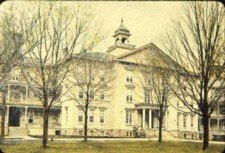
FOURTH BIENNIAL REPORT
OF THE
IOWA INSTITUTION
FOR THE
EDUCATION OF THE BLIND
AT IOWA CITY
TO THE
EIGHTH GENERAL ASSEMBLY
OF THE
STATE OF IOWA
JANUARY 10, 1860
Iowa City
Jerome and Tucker, Job Printers
1860
OFFICERS
Trustees
Robert Walker, President
Geo. W. McCleary, Secretary
R. Hutchinson, Treasurer
Trustees – Ex-Officio
His Excellency S. J. Kirkwood, Gov.
Hon. Elijah Sells, Sec. of State.
Prof. Samuel Bacon
TEACHERS
Samuel Bacon, Principal
Mrs. Sarah K. Bacon, Matron
Miss M. C. Christy, Assistant Matron
S. A. Price, Teacher of Music
John Cisna, Assistant in Mechanics Dept.
FOURTH BIENNIAL REPORT
OF THE BOARD OF TRUSTEES OF THE INSTITUTION FOR THE
INSTRUCTION OF THE BLIND
To the Hon. the General Assembly of the State of Iowa:
Gentlemen—In compliance with the provisions of chapter 56 of the acts of 1855, establishing this Institution, and requiring the Board of Trustees to make a biennial report to the General Assembly, of the condition of the Institution, number of pupils, studies pursued and trades taught; the receipts and disbursements of money, made on account thereof, respectfully submit the following report:
The Trustees of the Iowa Institution for the Education of the Blind, on presenting this their fourth biennial report, are much pleased to be able to report that the Institution entrusted to their charges has been from its foundation and is now fulfilling the most sanguine expectations of it friends. We have more pupils in the Institution in proportion of the number of inhabitance of the State than any other institution in the United States, and supported at less cost to the State than any other institution for the blind in the country, notwithstanding we have to rent the building we occupy.
The trustees have endeavored to exercise a judicious economy, but without any stint in the necessaries for the comfort and conveniences of the household. We believe that we but carry out the benevolent intentions of the Legislature, when we provide a most liberal support for the blind, and we should feel ourselves negligent of the trust reposed in us, if we failed to provide all musical instruments, maps, books and other appliances by which the education of the blind may be advanced, and their happiness promoted. And we are satisfied that the liberal appropriations to the Institution has and still is accomplishing much of that good which the Legislature designed it should.
Forty pupils are at present the recipients of the advantages offered by the Institution. We have also advertised freely and sent circulars to all the counties organized in the State, to announce that we were prepared to admit all the blind in the State of suitable age, capacity and character to receive instruction.
The number of pupils is gradually increasing, but we think the present appropriation allowed by the State, will be sufficient for the next two years, provided we remain in the building now occupied by the Institution.
But if the Legislature should make an appropriation sufficient to finish the building commenced at Vinton, by the 1st of July, 1861, than it will be necessary to make an extra appropriation of not less that four thousand dollars for removing the Institution and furnishing the new house in manner creditable to the State, and to make it comfortable for the officers, pupils and servants of the Institution. We think from the best information we can obtain relative to the building commenced at Vinton, that not less that fifty thousand dollars should be appropriated, if it is intended to complete the building with the necessary out houses, shop, stable, &c., before the next session of the Legislature.
We consider the location of he Institution as made by the last General Assembly particularly unfortunate for the interest of the Institution, and contrary to all precedent from the other States, which have located their charitable institutions, particularly those for the blind, with reference to the best interest of the Institution. But the principle seems to have been reversed in our State, and the Institution located with reference to the interests of the locality, instead of that of the Institution—a state of things unfortunate for the Institution, and detrimental to the interest and credit of the State.
But it is desirable that we have a permanent building for the blind of the State as soon as possible—and if the present session of the Legislature makes an appropriation to finish the building now commenced, we shall be every thing in our power to facilitate its completion, and if the appropriation should be placed in the hands of this board, it shall be faithfully and judiciously expended for that purpose. But if the Legislature should think it would drew too heavily upon the finances of the State, after the very large amount that will be required to finish and furnish the Asylum for the Insane, to make an appropriation for the blind, it is the opinion of the Board that the Institution can be accommodated comfortably for the next four or five years in the building it now occupies, if the number of pupils do not increase faster than we now have reason to expect.
In regard to the studies pursued and trades taught, we beg leave to refer to the report of the principal of the Institution, which is herewith submitted, which also contains a more definite statement of the condition of the Institution, its progress and management.
For the number, names, ages, sex, place of nativity and cause of blindness of pupils, see annexed statement marked A.
The receipts and disbursements of the Institution, for the term of two years, ending Dec. 31, 1859 are as follows:
Balance on hand as per last report $2,666.72
Cash received of State Treasurer 13,090.00
Other sources 70.00
________
Total 15,826.72
Amount paid out during said term 14,292.24
________
Balance on hand 1,534.48
All of which is respectfully submitted for your consideration.
Robert Walker
President of Trustees
REPORT OF THE PRINCIPAL
TO THE TRUSTEES OF THE INSTITUTION FOR THE EDUCATION
OF THE BLIND
Gentlemen:
In accordance with established usages, it devolves upon me to present this my fourth biennial report. By personal inspection and facts, which have been laid before you, from time to time, you are familiar with the management of the Institution; yet other suggestions have arisen, which are now presented for your consideration.
The school is in a more flourishing condition than at any former period, and prospects brighter for the future. Since the date of the last report, there have been twenty-five admitted, and ten discharged, leaving for the present number forty-one. Two others have been received, which it was thought not advisable to admit. They were returned to the counties from which they came, at the expense of the Institution.
The ratio between our present number, and the blind of the counties from whence they came, would give seventy for the whole State that aught to be in school at present. This is as great a number as Iowa will reach in ten years, owing to the great difficulty of inducing the blind to leave home. This number is as many as the building now being erected, will be able to accommodate.
If the same effort is continued to increase our number as that of the past year, (which ought to be) the building now occupied by the school will be filled next year to its utmost capacity. It would therefore, be wisdom on the part of the State to finish the building by September, 1861. The school aught not be moved until it is finished, nor during the session. It would be difficult to find another building which combines as many advantages as this. The health and cheerfulness of the inmates give evidence of the same. We have not be afflicted with sickness of a serious nature for the past four years. It is now nearly a year since the aid of a physician has been consulted, this we think a little remarkable as the blind are predisposed to disease.
There are many more that aught to be in school that we know of, some allege inability, others the distance, as an excuse. Really, it is no small expense to clothe a blind child, and bring them from the Western part of the State to the Institution. I would recommend the use of means for such extreme cases, and ask for authority to drew upon the counties for the same, as it is not the design of the Institution to clothe the pupils, but we have had to do it in some cases. If it is continued it may embarrass the finances of the Institution, as it does not enter the estimations for expenses. Thus we would remedy another evil that has arisen, of counties sending blind here that are unsuitable.
The appropriation for the Institution as it now stands gives sufficient means to manage the same with economy; it therefore ought not to be changed. There are many appliances that are desirable if there is a prospect of the building being completed soon. It will be better to forego their use at present. Therefore it ought to be known here as soon as practicable, when the building will be ready reception of the school, that preparations may be made accordingly.
In the opinion of the subscriber, he ought to have been associated with the commissioners for its erection. He ought to understand what is needed as well as any one in the State, having visited most of the buildings erected for the Blind in the United States, and spent the majority of his life in some of them. When the State determined to erect a building, I was requested by friends to present a plan, which has been adopted I understand with some alterations—whether they have been an improvement or not experience will prove.
I must in the name of the Blind of Iowa, protest against the policy pursued by the State—that if trafficking in our misfortune for the paltry sum of five thousand dollars, subjecting the blind of the State to great inconvenience, and the Institution itself to eternal disadvantage. An Institution for the Blind will suffer more from an improper location than any other eleemosynary Institution. Other States have located their institutions for the blind, at prominent points, with the direct reference to the advantage of obtaining material and disposing of manufactured articles, as well as the advantage the pupils may enjoy outside of the Institution for cultivating a taste for music. Their experience proves it to have been good policy. But as the Institution is located at Vinton, let the building be finished by the time the lease here expires—the 1st of July, 1861. Yet it would be better to lose all that has been appropriated and take the amount required to finish the building, and locate the Institution at the Capital, or some other prominent point in the State. With the addition to the yard, which is a great convenience, the rent is three hundred and seventy dollars per annum. When we consider the lose of improvements, and the cheap rent, the Institution cannot be moved, especially if it be not to the building erected for the purpose, for less than a loss of a thousand dollars, and if during the session, it will be equivalent to closing the school for six months.
According to the census report for 1859, Iowa has one blind to three thousand three hundred and eighty-two, but I believe it can be proven to be double that number,--some of the most populous counties give one to twenty-five thousand, and others on to less than two thousand, and some as one to six and seven hundred.—England gives one to twelve hundred. On the continent one to fourteen hundred. In New Mexico it is one to less than nine hundred. In this country where there are but few that lose their sight from small-pox, and from mixed races there will be less congenital cases, we need not expect blindness to be quite as frequent. I have never yet went into a county to look up the blind without finding double what is reported, some times when one is reported, I will find eight. The interest you have taken in looking up the blind for the past year, if it is continued for two or three years, will bring to our knowledge most of the blind of the State. It will also give the public more knowledge of the Institution, of its existence there are but very few that know, and less of its object. Greater care ought to be observed when the census is taken, to give the name and age. It appears to me, if it were made obligatory on the Secretary of the School Board, to return all blind persons, with their names, age and the degree of blindness, when he takes the number of children, that a great deal of useful information might be collected with very little trouble. There are about one and four of the blind in Iowa that ought to be in school. It will be about one in eight in a few years.
I would suggest the propriety of employing some good oculist to visit the Institution once or twice a year. There are many cases which do arise, that relief from pain and benefit to the vision may be had—and there are many throughout the State, who are blind that have hopes of recovering their sight, and employ those who know but little about the treatment of the eye, and thus irrecoverably lose their sight, and affect their health. Perhaps then they will be sent to the Institution to be nursed. Others who have no confidence in physicians around them, and for the want of means are not able to apply to a good oculist, neglect theirs until it becomes permanent. If it was understood that they could have the benefit of a skillful oculist, many would come in that are now kept away through hope. Perhaps, some might be cured. Certainly relief from unnecessary suffering would be infinitely better than their present situation.
Mr. John Cisna, one of our first pupils, has discharged the duties of teacher of mechanics for the past year successfully. If the pupils by their ingenuity and industry can make themselves useful, it is the duty of the Institution to encourage them by giving them employment, when we need help. This will have a good influence on the school. If we do not place enough confidence in our pupils to employ them, it will be a poor recommendation to the public.
From the system employed in instructing the blind, the sympathy and prejudice of the teacher are impressed on the pupils. ---they should, therefore, be selected with great care, nor have so much to do, that they manifest any weariness. It is not advisable to increase or change the teachers, yet a better classification of the scholars ought to be made. It is necessary here, as in a larger school, and must be done soon.
It has been promulgated from high authority, that it would be policy for the State to abolish the Institution. I will state without fear of contradiction, that this Institution has had greater number of pupils, and managed with less expense then any other similar institution in like circumstances.
The course of instruction is thorough and as extensive as in most similar institutions. There are three departments, Industrial, Musical and Academical, which have respectfully have two, three and four hours a day devoted. In the Industrial department, the females are employed in sewing, plain and fancy knitting and bead work. The males are employed in brush and broom making. I do not consider brush-making an excellent trade for the blind, yet it has its advantages over every other trade usually taught the blind, for it teaches them how to use their hands and fingers, also, the proper use of tools. This is a great consideration for many of them when they come to us cannot tie a knot. Not that the pupils here are dumber than elsewhere, but blind children generally everywhere are impressed with the idea of their inability to help themselves. Wherever there is one with the strength of will sufficient to break through such impression, he will succeed.
Breading mats has been abandoned as unsuitable for the blind. Broom-making I consider THE trade—one which they can work at with facility, and set up at any place at trifling expense; and find sale for all they can make. The beadwork which we teach our younger pupils, is of great utility in strengthening their fingers and developing their ingenuity. Our older female pupils have been engaged in knitting sypher hoods, for which they find ready sale faster then they can knit them.
Music embraces the theory and composition, as well as vocal and instrumental music. Our choir probably sings as well as any in the State. There are eleven performers in the Orchestras, we hope to put in four more soon.
The Academic course at present embraces geography, reading raised print, writing, grammar, logic, rhetoric, arithmetic, algebra and geometry. In addition to the above courses, the news of the day is read to the pupils from various newspapers sent to the Institution gratis, for which the editors have our thanks.
The discipline is mild but firm—free from corporal punishment, keeping the improvement of the pupil constantly in view. We know of no reason why the discipline of the blind should differ a particle from that of the seeing, or the course of instruction. The manner of conveying that instruction is necessarily different for the want of suitable apparatus. The method pursued is oral, which makes it more thorough and consequently better, but more laborious for the teacher. No sectarian views are taught, but a due reverence and respect for the Supreme Being is inculcated at all times. If the weather will permit, all the pupils are expected to attend church on the Lord’s Day.
This Institution is free to all the blind of Iowa, of suitable age and capacity to receive instruction. Nothing es expected of them or their friends, except to defray their traveling expenses to and from the Institution, and furnish them with suitable clothing. The time for instruction commences the first Monday in September of each year, and closes the third Saturday in June. The pupils are expected to spend the vacations at home with their families.
Anyone applying for admission, or desiring information, had better direct to the care of the Institution. This will avoid delay.
Gentlemen, I will close this communication with a quotation from my friend and teacher, who has had more experience in the school room with the blind, than any other teacher in the Union. If this should come under his observance, he may be reminded of the agreement entered into years ago by the pupils of the Ohio Institution. I was there three years ago. My feelings were those of a weary child, after years of wondering that had returned home to receive instruction and consolation, but found it occupied with strangers. Thy place was filled with another. I heard not thy cheering voices. I will be there at the re-union of the pupils, the Fourth of July, 1860—Providence permitting.
“It is a wise provision in the beneficent economy of Providence, that allows the weak, by way of compensation, to seek support from the strong, as the vine, by its tendrils cleaves to the sturdy oak, encircling it with beauty, until it is crowned, as it were, with a garland of glory, studded with clusters of luxurious fruit; so would our pupils unite in hymns of thanksgiving, that their hands have been emancipated from helpless inactivity, and their minds unfranchised from the thralldom of ignorance, to satiate themselves in the bright luminary of knowledge, while hope for the first time enkindled in the hearts of some, in others happily reawakened, promotes them to achieve an honorable independence by active industry.
It is confidently hoped that results like these will still commend the Institution to the fostering care of our State Legislature.
Respectfully submitted,
Samuel Bacon, Principal
Iowa City, December 31, 1859.