SIXTH BIENNIAL REPORT
OF THE
IOWA INSTITUTION
FOR THE
EDUCATION OF THE BLIND
LOCATED AT VINTON,
TO THE
TENTH GENERAL ASSSEMBLY
JANUARY 11, 1864
DES MOINES
F. W. PALMER
State Printer
1864
OFFICERS AND TEACHERS
TRUSTEES
HON. ELIJAH SELLS, President
JAMES CHAPIN, Treasurer
O. CLARKE, Secretary
TEACHERS
PRINCIPAL
ORLANDO CLARKE
ASSISTANT TEACHERS
N. C. ROBINSON
MISS AMELIA BUTTLER
TEACHER OF MUSIC
S. HARDIN PRICE
MATRON AND TEACHER OF HANDICRAFT
MRS. H. L. CLARKE
TEACHER OF MECHANICS
JOHN CISNA
REPORT OF THE PRINCIPAL
To the Trustees:
Gentlemen:---Your personal watch, care, and frequent examinations of the affairs of the Institution for the past two years have so familiarized you with it growth, attainments, necessities, finances, and other affairs as to render any details from me unnecessary. Accept my heartfelt gratitude for that assistance and co-operation which has aided and sustained me in my arduous, yet delightful duties.
Iowa Institution for the Blind
Vinton, January 1, 1864
REPORT OF THE PRINCIPAL
To the Honorable, the General Assembly of the State of Iowa:
Gentlemen: The Iowa Institution for the Education of the Blind has had a marked prosperity during the past two years. Rapid advancements have been made in all the various branches of the literary, musical and industrial departments. The standard of deportment and attainments have been elevated. The aim of Trustees and teachers has been to give a practical education to all the blind of Iowa capable of education.
In compliance with the law, tables are annexed exhibiting “the whole number of students, and the time actually in attendance in each year;” with name, age, sex, place of nativity and cause of blindness for each pupil. Also an account of the studies pursued and trades taught. The whole number of pupils enrolled is sixty-one. About one-half of that number had never enjoyed the privileges of the institution before; and there are yet scores of blind youth in this State, enduring the long and cheerless night of physical and mental darkness, who ought speedily to be gathered into the school. There may be found sitting by the fireside of scanty homes, and within the walls of your poor-houses, many such, whose physical natures are being dwarfed; whose faculties and energies are wasting for want of action, and their “immortal minds” starving for the light of truth and knowledge; who might be speedily transformed and their faces made to beam with joyous animation and intelligence by a proper education. There are also many adult blind, now helpless dependence, dragging out a listless, inactive existence, who by proper training in handicraft might become industrious, self-sustaining and independent citizens. The census returns for 1863 shows 295 blind in Iowa. And one of the effects of the present war will be rapidly to increase the number. Already several soldiers have returned rendered blind in the service of our country. There is also reason to believe that some local cause productive of blindness exists in our midst. Perhaps it may be the prevalence of the violent and almost constant prairie winds, bearing with them dust and sand, which produces so many causes of ophthalmia. The causes of blindness of the inmates for the last two years are as follow:
Ophthalmia 26 cases
Various accidents 10 cases
Congenital 7 cases
Various fevers 7 cases
Scrofula 4 cases
Amaurosis 3 cases
Measles 2 cases
Neuralgia 1 case
Cancer 1 case
Cause unknown 1 case
REMOVAL
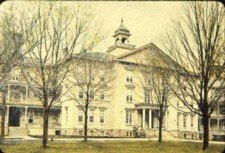
By direction of the board of trustees the goods and furniture belonging to the institution were removed from Iowa City to Vinton, in August, 1862, and by the kindness of the contractors of the new building, Messrs. Finkbine and Lovelace, such rooms as were necessary for occupancy were speedily finished, and we were enabled to furnish the same and open the school with 24 pupils early in October, although the building was not completed until late in November. The new edifice is upon a slightly elevation of a piece of land containing 40 acres, which belongs to the institution, and is situated one-half mile south-west of the village of Vinton. It is of hewn limestone, easily chiseled, but which hardens by exposure. Fronting to the east, it is one hundred feet long, and seventy feet wide, four stories high including the basement, and capable of accommodating about 80 pupils. The roof is of pine, and the building being warmed by stoves, there is a fearful liability to fire from the chimneys. At the time of removal the grounds were an unbroken prairie. The water from the roof of the building in times of heavy rain, for want of sewers, ran into the basement. The amount of earth, and stone, and rubbish, which had accumulated with the erection of the building was immense. Such improvements therefore as were absolutely requisite in order to its occupancy were made under the direction of the Board of Trustees. A part of the grounds were broken and fenced, the rubbish removed, sewers and walks, and roads were constructed. A temporary woodhouse and stable were built, a large number of trees were transplanted, and a cistern and well provided.
The interests of the institution require the immediate erection of a building which shall combine the purposes of work-shops, and gymnasium, and vegetable cellar: also, the construction of an area wall around the main building to prevent dampness in the basement rooms, and to prevent the main walls from injury. The President of the Board has authorized the recommendation that one thousand dollars be appropriated for the construction of the area wall; and the further sum of four thousand dollars be appropriated for the erection of workshops. Said improvements to be made under the direction of the Board of Trustees.
HEALTH
It is a source of great satisfaction, as well as a cause for devout gratitude to God that the health of the inmates has been almost uninterrupted during the past two years. Only three or four cases of sever sickness have occurred; and these, by the faithful watch-care of the Matron, and the promptness and skill of the Physician, soon yielded to treatment. The almost uniform health of the pupils, is due in part to the healthful location, to the spacious halls and sleeping apartments, to a simple and wholesome diet; but especially to the active exercise of body and mind, required of all, and the cheerful associations of institution life, by which their morbid tendencies have been counteracted. No physician has been regularly employed, but the preferences of the sick have been consulted. Dr. Boyd and Clingan have generally been called, and have been prompt and successful.
CHEERFULNESS
The blind are capable of about the same happiness as the seeing; yet it is a constant source of wonder to observe that the blind should so cheerful. The merriment, the joyous emotion, the cheerful song, and the ringing laugh, heard in the halls and upon the play-grounds in times of recreation, seem to visitors incompatible with blindness. It is true the blind generally ejoy themselves better in the Institution than in any other place. And the great secret of their happiness is that they are employed. Activity removes that mental, moral and corporal rubbish which too often accumulates in the seclusion of home. And life, therefore, ceases to be a “stagnant pool” and becomes as the “living water,” clear, pure and joyful.
COMPENSATION
In the increased tenacity of the memory, in the more exquisite sense of touch, in the quickness of hearing and delicacy of smell consequent upon blindness, there is a partial compensation for the misfortune. The perceptives are so refined that some persons entirely destitute of the organs of sight, upon stepping into a room for the first time, will tell at once about the size of the room and whether it is occupied. They will not walk against an animate or inanimate object of the size and height of a man, unless it be in times when there is confusion of sounds. In the city they will readily distinguish the open spaces from the buildings. And in the varied landscape, they will indicate the direction of the hills and forests, from that of the valley or lake. The blind themselves may not be able to give a satisfactory explanation, yet they will doubtless testify that not having eyes they “see” those things in their own peculiar way. The necessary intervention of the blind i[pm itself is in many respects favorable to mental culture. They tell us that Democritus put his own eyes out in order to make himself a better philosopher. And that Malebranche in order to put his mind to its utmost energies was accustomed to close the window shutters of his study and contemplate in darkness. The blind have the windows always closed and therefore easily concentrate their mental energies.
THE SCHOOL
The same teachers have continued since the opening of the school at Vinton. And the success which has attended their efforts is a pleasing evidence of their faithfulness and efficiency. The recent exhibition in your Legislative Hall of the attainments made by many of the pupils, and your personal examination of them in the various branches of study enables you to judge not only of the capacity and industry of the scholars, but also for the fidelity and zeal of Trustees and Teachers. The method of government has been, first, to create a high sense of duty, propriety, integrity, and virtue; and them to appeal to that sense as a motive to proper conduct. The prevailing spirit among the pupils has been that of subordination and gratitude to teachers, and of “peace and good-will” towards each other. To the influence and example of the older pupils, is due especially the pleasing state of harmony and discipline which characterizes the school. Eugene Ketcham, Margaret Marrin and Josephine Porter pupils in the school, have rendered important assistance in teaching.
The principal studies pursued are as follows:
Reading raised print
Orthography and Definitions
English Grammar
Geography
Arithmetic
Writing with grooved board and pencil
Writing with Braille’s apparatus
History
English Literature
Rhetoric
Physiology
Natural Philosophy
Natural Theology (Paley’s)
Mental and Moral Philosophy
Algebra
Geometry
Astronomy
Thorough Bass
WRITING
The facility with which the blind learn to write by means of a grooved board and pencil is remarkable. Many write legible letters to their friends in this way. The deficiency of this method is in the fact that the blind cannot read what they write. Braille’s method of writing introduced into the school by the President of the Board of Trustees, Hon. E. Sells, about one year since obviates the difficulty of the former method and enables the blind to communicate with each other by writing without the aide of the seeing. By this method they can record their own composition, facts, dates, music &c., and then refer to, and read the same at pleasure. The special design in the introduction of Braille’s method was to assist the pupils in learning orthography, and in this it was effectual.
MUSIC
The services of Prof. Price, the accomplished teacher in this department, have been invaluable. From two to three hours each day are devoted to music.
The Band, composed of fifteen performers, execute with surprising skill the compositions of their teacher,---our national airs, and a number of overtures and other compositions of the masters in music.
The chorus, consisting of about forty persons, sing some of the finest sacred and secular choruses with thrilling effect. The pupils are thoroughly trained in the theory, and composition of music. Some of them compose music with facility and bid fair to make competent teachers. Miss Porter, a pupil, teachers a class in vocal music.
INDUSTRIAL DEPARTMENT
The work department of males has been carried on under very great discouragements for want of work shops and materials. A room in the main building has been fitted up as a temporary shop, but it is not competent to accommodate one half of the pupils in handicraft. The preference has been given to those pupils to whom a trade seemed most important. Mr. John Cisna, the teacher In handicraft has resolutely persevered against all inconveniences and a number have learned to make excellent brooms, brushes and door mats.
In the industrial department for females, under the direction of the matron, assisted by Miss Marrin, a pupil, great proficiency has been attained. By patient industry the pupils have acquired a skill in sewing, knitting and the manufacture of bead work, which commands the approbation of the trustees and teachers.
At the suggestion of the matron, the blind girls made a fine collection of fancy worsted and bead work, which, as personal donations for the benefits of our soldiers, were sent to the North-Western Sanitary Fair, held at Chicago in October last. The contribution elicited the following notice from the Chicago Journal:
“And here is something that attracts great attention from everybody, and excites the admiration of old and young. It is a beautiful display of bead and worsted work, wrought by the wonderfully ingenious and delicate fingers of the girls of the blind institution at Vinton, Iowa. Patiently they have toiled in their noble and generous work, and have produced from their long, dark night a display of articles as rich and beautiful as any surrounding them, which will be doubly prized by their purchasers as a donation to a worthy cause from hearts that feel, though they cannot see. God bless the loyal blind girls.”
Quarterly reports from the industrial departments are made to the Board of Trustees, and the proceeds therefrom are paid to the Treasurer.
RECAPITULATION
The following is a recapitulation of the disbursements made under the direction of the present Board of Trustees, for the years 1862 and 1863:
Paid for Salaries of officers and teachers $2,586.60
“ Groceries and provisions 4,298.46
“ Labor 1,354.96
“ Fuel 578.75
“ Hardware cutlery, oils and drugs 408.29
“ Furniture 336.04
“ Bedding 338.73
“ Carpets and matting 617.80
“ Stoves and stove pipes 303.89
“ Queens ware 110.22
“ Books, stationary printing and postage 233.64
“ Freight and Express charges 98.67
“ Medical attendance 68.00
“ Braille writing apparatus &c. 110.00
“ Removal expenses 319.58
“ Music and musical instruments 703.36
“ Beads wire and worsted 183.00
“ Broom-brush, handles, wire &c. 170.64
“ Oil cloth, lamps, curtains, fixtures &c. 463.97
IMPROVEMENTS
Paid for Labor and material for fencing grounds 412.11
“ Copula, to Messrs. Finkbine and Lovelace 750.00
“ Extra spouting and drain 9.15
“ Work on cistern 18.50
“ Stone masonry for sewer and vaults 201.50
“ Carpenter work on out-buildings 215.05
“ Stone masonry on rear wall 149.97
“ Railing on same 54.25
“ Hauling finishing lime 60.75
“ Extra carpenter work in building 58.75
“ Force pump 14.00
“ Painting 17.20
“ Well 54.01
“ Lumber for temporary wood-house 98.92
“ Lumber for railings 16.35
“ Grading around building 63.85
“ Copper lightning rod 88.10
“ Cleaning off grounds and making walks 280.75
“ Breaking ground finishing and planting trees 122.60
--------------
15,971.41
Amount on hand in treasurer January 1, 1864 1,586.08
--------------
17,557.49
By the practice of a judicious economy, together with the advantage of a balance in the treasury, which accumulated in times of cheap subsistence, the Trustees have been enabled to keep the Institution free from debt, and preserve a balance in the treasurer. In view, however, of the advance in the price of labor, provisions, furniture, bedding, &c., and the pressing need for musical instruments, raised books and maps, and machines for the work-ships, an increase of twenty-five per cent upon the former appropriation will be necessary in order to carry forward the Institution efficiently, and in a manner creditable to the State, for the next two years. Considerations of economy and of humanity prompt to ample and efficient provision for the education of the blind capable of instruction. The liberality of your State has erected a building suitable and competent for all purposes except a mechanical department. It therefore only remains that workshops be erected and furnished, and that suitable provision be made for musical instruments, books, maps and other appliances for teaching, and for the current and ordinary expenses of the Institution.
In reviewing the past two years, the officers and teachers have the satisfaction of knowing that substantial progress has been made, although in the face of many disadvantages. The Principal and Matron desire to tender their grateful acknowledgements to Mr. Samuel Bacon and wife, the former Principal and Matron, and also to officers and teachers in the Boston, New York and Philadelphia Institutions, for valuable suggestions gained by personal council and observation.
For what has been accomplished devout gratitude is due to the Giver of all good, whose providence hath fulfilled those words:
“And I will bring the blind by a way that they knew not. I will lead them in paths that they have not known.
I will make darkness light before them, and crooked things straight. These things will I do unto them and
Not forsake them.”
The cordial gratitude of the pupils, though it were not expressed, is none the less felt towards the Trustees the Legislature, and the people of the State, for that interest and liberality which has established and sustained this Institution, again commended to the fostering care and liberal patronage of your honorable body.
Respectfully submitted
ORLANDO CLARKE, Principal
Iowa Institution for the Blind
Vinton, January, 1864